


This is an interview with Finn Tropy of Finn’sights.
At a glance:
Current subscriber count: 1329 (finntropy.substack.com), 113 (stackcontacts.substack.com)
Most successful post: “How Often Should You Publish Notes to Grow Your Paid Subscribers?“ (Dec 2024) — 72 total signups, 3,227 views, 252 reactions, 96 comments, 42 restacks
Most underrated growth tactic: Restacking as asymmetric relationship-building.
It’s the only growth tactic that simultaneously signals your taste, gets you in front of another creator’s audience, rewards the algorithm (Substack explicitly surfaces writers with restack activity as audience-adjacent), and builds a relationship — all without asking for anything. Every other tactic has a cost: posting takes time, cold outreach asks for something, recommendations require reciprocity.
The underrated part: most creators think of restacking as amplification. I’ve framed it as discovery — specifically, restacking Tier 2 peer-sized creators (1k–10k subs) to get on their radar without asking for a recommendation. That framing is more precise than anything most Substack growth advice covers.
Favorite Substack feature: Substack Notes.
One creator everyone should follow: Yana G.Y. - I’ve learned so much from her, and we built two very successful collab products together.
One tool you can’t live without: Claude AI
Key metric to track: Notes-sourced subscribers.
Main revenue source: Gumroad - my software products for Substack creators
One sentence describing your newsletter: What worked, what didn’t, and the tools I built along the way — for Substack creators who want real growth, not guessing.
One piece of advice for new writers:
Publish before you’re ready — the data doesn’t exist until you create it.
Creators who wait until they have the “right” strategy have nothing to measure and nothing to improve. The experiment can’t start until you hit publish.
The Beginning
Tell us about your publication. What do you write about and who is it for?
I have two publications:
Finn’sights (finntropy.substack.com) is for Substack creators who are tired of vague growth advice and want actual data. I write about what works, what doesn’t, and the tools I built along the way.
The typical reader is already publishing. They have somewhere between 10 and 2,000 subscribers. They’re not trying to become a media company — they want a sustainable creative business that fits their life. My job is to give them the honest numbers and the tools and systems to make that happen.
I don’t write for beginners who want a 10-step checklist. I write for people who’ve been at it long enough to know that “just be consistent” is not a strategy.
StackContacts (stackcontacts.substack.com) is a newsletter for Substack creators who sell digital products and want to grow with data, not gut feeling.
I write about turning subscriber and Gumroad data into decisions — which content drives sales, who’s about to churn, which subscribers are most likely to buy. It’s built for StackContacts tool users who want to go beyond the dashboard and actually use their data to earn more.
What was your writing journey before Substack?
I’ve been writing software since 1976. For most of my career, the writing I did consisted of code, specs, and technical documentation, as well as thousands of corporate emails, reports, and product documents. I’ve written some blog posts about my hobbies, and dabbled in writing Sci-Fi stories, but I didn’t really know how to write online or how to do marketing.
As I was preparing to retire from the corporate world, I started writing on Medium in 2023. Mostly because it was the obvious first move when you want to write online and don’t know where to start.
The writing itself wasn’t the hard part. Figuring out who I was writing for — and why — took much longer.
How was your Medium publication performing before you discovered Substack?
I’d write something, it would get a few hundred views if I was lucky, and then I’d never hear from those readers again.
Someone would clap on a post, maybe follow me, and disappear. I had no way to reach them. No way to know if they were still reading. No way to know if any of it was landing.
After 18 months, I had readers — but I couldn’t name them, couldn’t contact them, and had no idea what they actually wanted from me.
On June 9, 2024 I imported my 24 subscribers to Substack, initially as a test. One of them threw a fit because I sent a welcome email from Substack. I immediately removed him, but he publicly blamed me in a post because “him subscribing to me was only for Medium stories.”
This was my first lesson on how some people who had been reading my stuff for 18 months could react so negatively when I tried something new.
Did you immediately move over, or did you run both platforms simultaneously for a while?
I ran them simultaneously for a few months. In November 2024 I decided to focus on Substack only and stopped publishing on Medium.
What made you start on Substack in the first place?
I was doing what I do now, but on Medium. Analyzing creator growth. Looking for patterns. I wrote a mini-series profiling accounts like Tim Denning and Eve Arnold — their consistency, their topic mix, their engagement curves over time.
Then a new account appeared. Ten weeks in, it had a larger following than creators who’d been building for years. The growth pattern looked wrong. I wrote about it. Other readers started bringing their own evidence. The thread got traction.
Medium leadership commented publicly to say the account was real. Then they took my post down for “mentioning other accounts” — a community rules violation.
I hadn’t written anything false. I’d published my analysis. But the platform decided that analyzing other creators metrics was against their rules — even when the analysis raised a legitimate question.
That was the first signal.
The second came when I started using AI tools that summer. English is my third language. I was using Grammarly to clean up grammar — not to generate content — but Medium publications started rejecting my stories.
AI-written content was banned, and the distinction between “grammar tool” and “ChatGPT” didn’t matter to the editors.
Two things became clear at once: Medium didn’t want analysis of other creators, and it didn’t want writers who used AI tools. Those were exactly the two things I was building toward.
I didn’t gradually drift to Substack. I left Medium.
What did your first few months on Substack look like?
Slow. Humbling. I had a handful of subscribers who I’m pretty sure were mostly people I knew. The open rates were high — which felt good until I realized a 70% open rate on 30 subscribers is still 30 subscribers.
I published more than I expected to. I was experimenting, not executing a strategy. And that was probably the right call. The experiment can’t start until you hit publish.
At what point did you realize this could become something bigger?
When I started getting data from my own readers that contradicted conventional wisdom.
I published a post called How Often Should You Publish Notes to Grow Your Paid Subscribers? in December 2024. It hit 3,227 views, 252 reactions, and drove 72 total signups.
That was the moment I realized the newsletter wasn’t just a place to write — it was a research platform. My readers were hungry for the real numbers, not the guru version.
That post also validated the product direction. If people cared this much about Notes strategy and data, they’d pay for better tools. And they did.
The Growth Story
Can you walk us through your subscriber growth journey?
The first 100 were slow. Mostly organic — people found me through Notes or a post landed somewhere useful. I wasn’t doing much outreach or any paid promotion.
The jump from 100 to 500 happened when I started treating Notes as a growth channel instead of a broadcast tool.
I stopped posting announcements and started posting data. One Note — “I analyzed 1.78 million Notes and found the 30–60 word sweet spot” — drove 18 new free subscribers and 234 clicks in a single post. That changed how I thought about the format.
The jump to 1,000+ was driven by a combination of restacking, data-backed posts, and the product flywheel.
When I launched StackContacts and Substack Pro Studio, people bought the products and then subscribed to the newsletter to understand how to use them. The audience and the business started feeding each other.
Today I’m at 1,329 subscribers on Finn’sights and 113 on the StackContacts publication.
What were the biggest growth drivers?
Three things, in order:
Notes with data hooks. Not “here are some tips.” Specific numbers. “I scraped 3.8 million Substack posts. The sweet spot for engagement is 1,600 words. Engagement dies after 2,000.“ That kind of specificity gets restacked because it’s useful and hard to fake.
Restacking as relationship-building. Not amplification — discovery. I focused on Tier 2 creators (1k–10k subscribers) who were building seriously but hadn’t hit scale yet.
Restack their work, do it consistently, get on their radar. No cold outreach. No “let’s collaborate.” Just signal that you’ve read them carefully.
Posts that challenged the consensus. How Often Should You Publish Notes to Grow Your Paid Subscribers? was the highest-performing post I’ve published — 3,227 views, 252 reactions, 43.6% open rate. It worked because it gave people data that disagreed with what they’d been told.
In another post, Have I Found Out The Best Time To Publish, I conducted a statistical analysis to debunk the common belief that the best times to post are in the morning and evening in US time zones. That post brought 12 subscribers and had an amazing 58.97% click-through rate.
What’s one thing that worked much better than you expected?
Building software.
I thought the newsletter was the product. Turns out the newsletter is the marketing engine. The software products are where the money is.
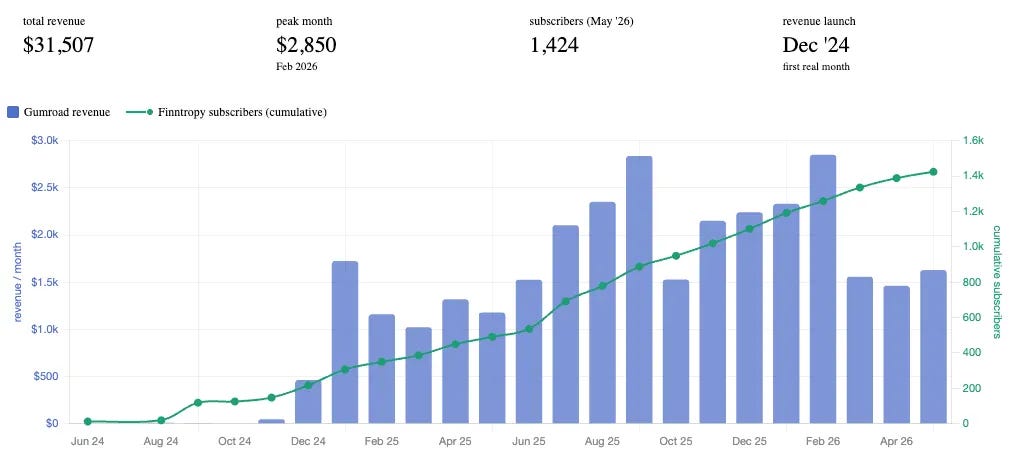
Since August 2024, I’ve done $32,000+ in Gumroad revenue across 1,937 sales — mostly from free subscribers who never converted to paid newsletter readers.
The most successful product, Substack Scheduled Notes, has 502 customers. My second, Substack Pro Studio, has 356.
That’s the backwards funnel I didn’t plan for: build in public → earn trust → sell tools → audience grows because the tools work.
What’s something everyone says to do on Substack that didn’t work for you?
Paid subscriptions as the primary monetization model.
I have 3 paid subscribers on stackcontacts.substack.com. Zero on Finn’sights. And I’ve made $32K from products sold almost entirely to free readers.
Everyone told me to put the best content behind the paywall. That the paid subscription is the goal. For me, the goal is a reader who trusts me enough to buy something that solves a real problem.
The newsletter earns that trust. The products capture the value.
This won’t work for everyone. If you’re writing long-form journalism or deeply personal essays, the paid sub model makes sense. But if you’re teaching a skill or solving a problem, think about what the product version of that looks like.
If you had to start from zero tomorrow, what would be your first 30 days strategy?
Days 1–7: Publish one post. Not perfect. Just real. Something you already know that most people get wrong. The data doesn’t exist until you create it.
Days 8–14: Write 10 Notes. Short. Data-backed or story-driven. Find 5 creators in your niche with 50–500 subscribers and restack one piece of their work that genuinely impressed you, with comments. Not flattery. Actual signal.
Days 15–21: Find the one question your ideal reader asks most. Write a post that answers it with specifics, not principles.
Days 22–30: Email your list — even if it’s 12 people — and ask them one question. What’s the one thing you’re still confused about on [your topic]? Read every reply. That’s your next 90 days of content.
Don’t think about monetization yet. Think about what you know that’s genuinely useful and hard to find elsewhere.
Behind the Scenes
What’s your content creation process like today?
I’m working part-time on my tools, so the newsletter gets 2-4 hours per week — early mornings, occasional evenings, sometimes a Sunday block.
The process is research first.
I run queries on my own data (subscriber behavior, Notes performance, Gumroad sales correlations, Social graph effects). If I find something surprising, that’s the post.
The insight drives the structure; the structure drives the words. I’m not sitting down to write a post — I’m sitting down to report a finding.
Notes are faster. A good Note is usually a single observation I can support with a number. I draft them in batches, schedule them with my own tool (Substack Pro Studio), and move on.
How often do you publish, and how did you find that rhythm?
About once a week on posts — the actual average is every 8 days. Notes are daily: I’m publishing around 4–5 Notes per day, which works out to roughly 30 per week.
I didn’t find the rhythm through discipline. I found it through systems.
The Notes get scheduled in batches using my own Substack Pro Studio tool — I’m not sitting down every morning to write one from scratch. I draft them in blocks, queue them, and they go out on their own.
The posts come when the research produces something genuinely new. Some weeks that’s one post. Some weeks it’s two or three in a row when I’ve been deep in data.
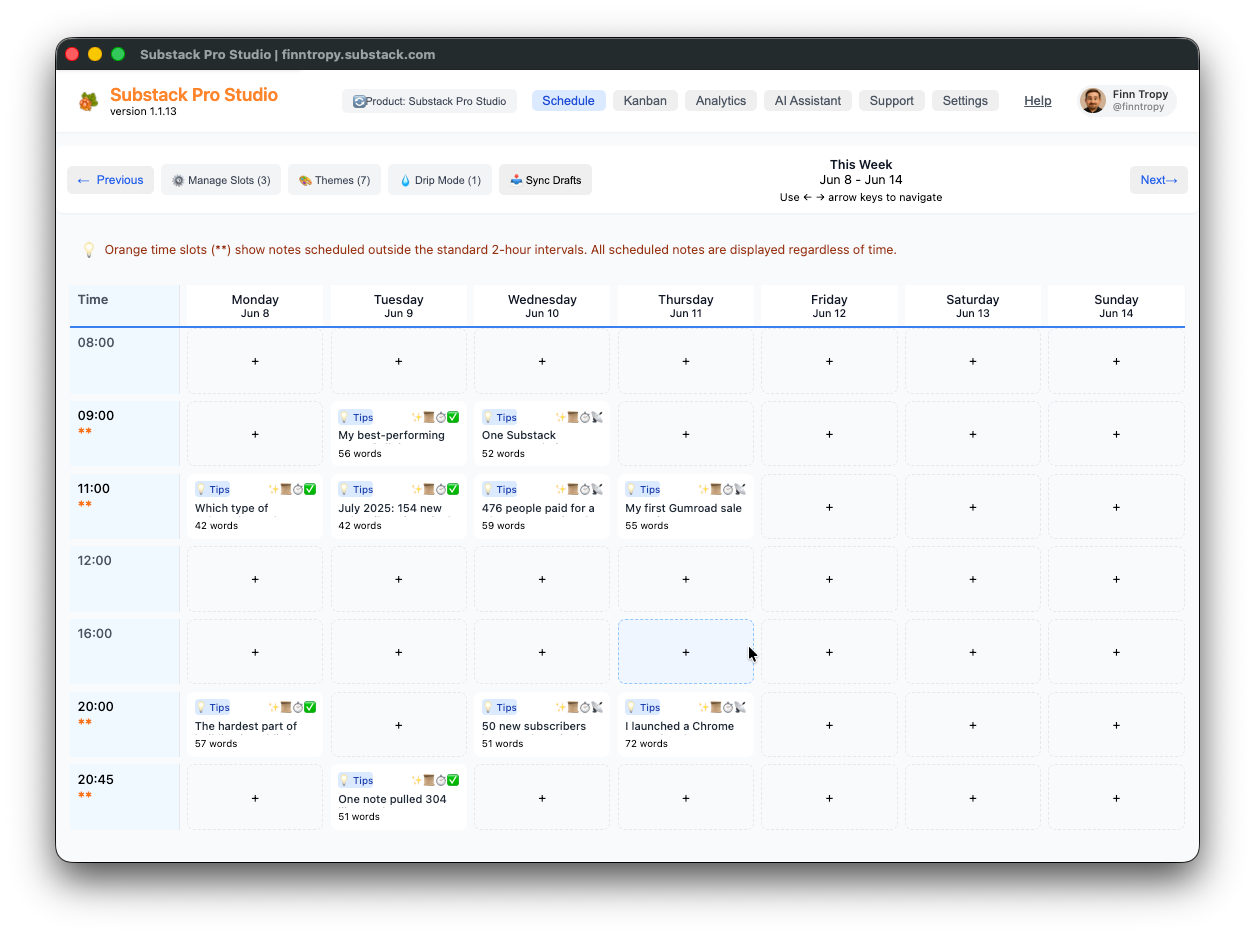
The key distinction: Notes are consistent by design (the tool handles the cadence). Posts are consistent by research (the data tells me when there’s something worth sending). Two different rhythms, for two different purposes.
What metrics do you actually pay attention to?
These three:
Notes-sourced free subscribers. This is the primary growth metric. Notes are the top of my funnel.
If a Note doesn’t convert — doesn’t add subscribers — I need to understand why.
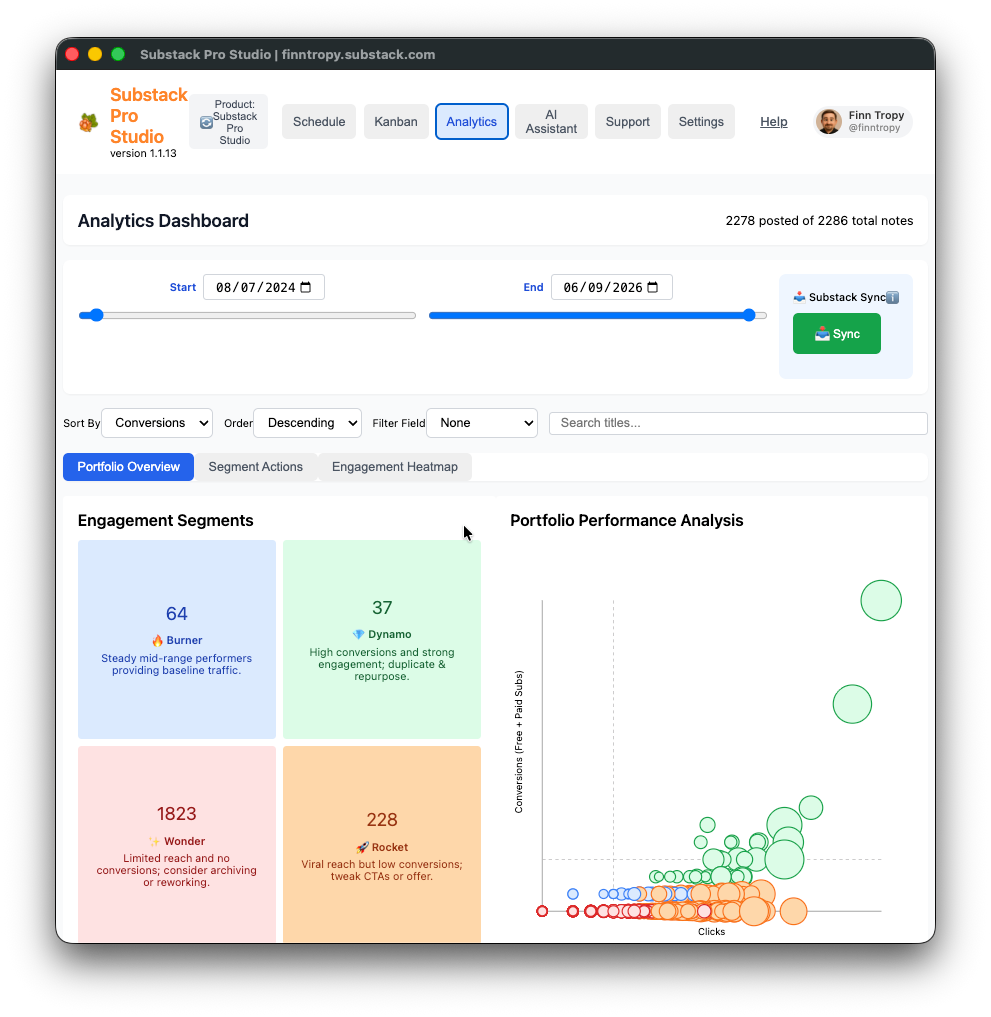
Link click rate on posts. Not open rate. I used to track opens. That was a mistake.
After pulling 69,522 Substack events and 1,244 Gumroad transactions into an analytics database and running it through AI, one signal stood out: 88.9% of purchasers clicked at least one link before buying, compared to 15.6% of non-purchasers.
Link clicks are 4.5× more predictive of purchases than opens, comments, or total engagement. Open rate feels like the right thing to watch. The data says otherwise.
Email opens = interest. Link clicks = intent.
I wrote this article How I Used AI to Find the Hidden Behaviors That Predict Which Readers Will Buy on the data analysis and conclusions.
Gumroad revenue by product. Which product is still growing, which has plateaued, where is there a gap. This is my actual business metric.
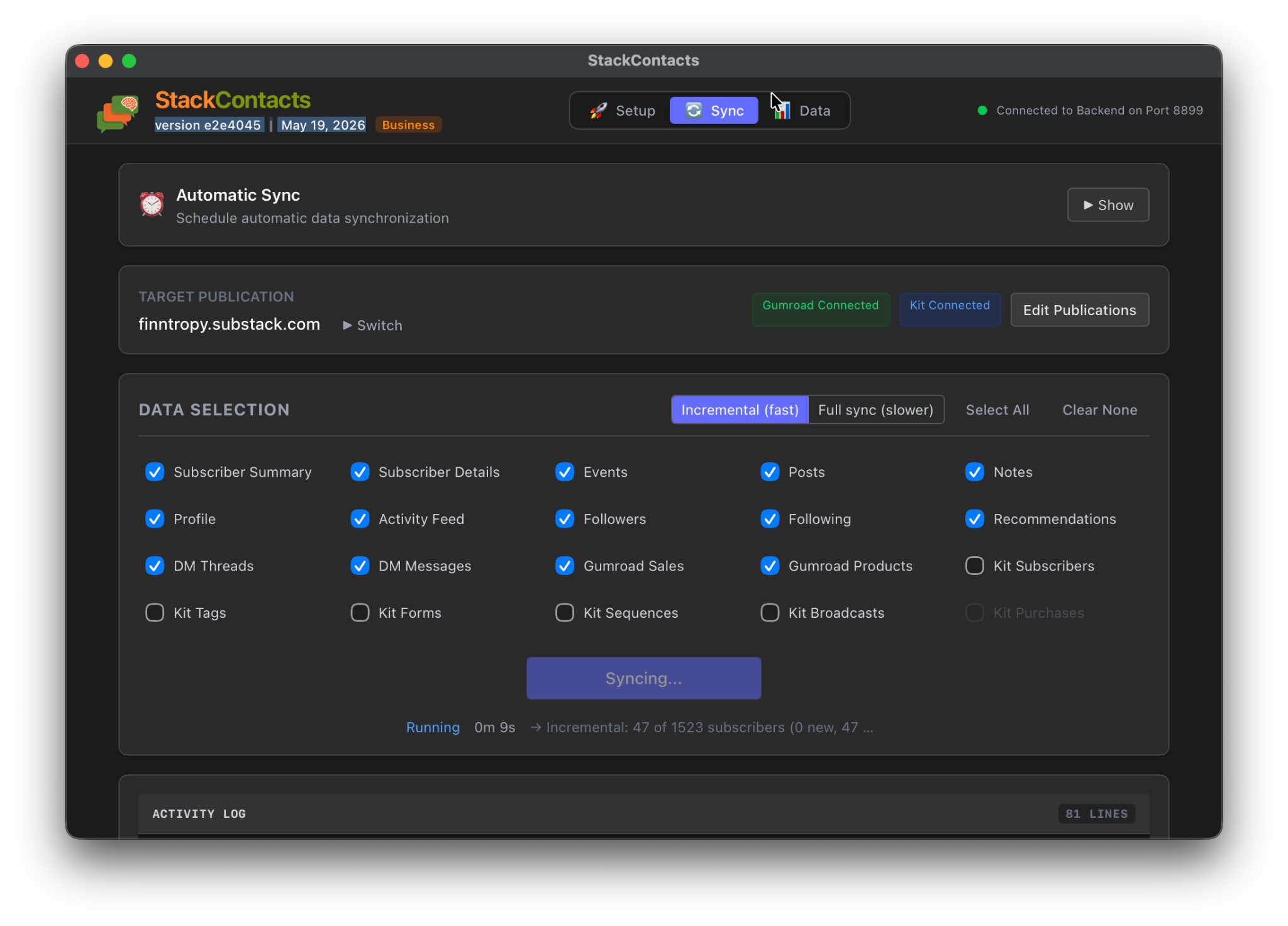
I built StackContacts specifically because Substack’s native analytics couldn’t surface these behavioral signals. The platform shows you opens and views. It doesn’t show you who clicked a product link twice but didn’t buy. That’s the gap the tool closes.
What was the biggest mistake you’ve made on Substack?
Waiting too long to understand who my audience actually was.
For the first several months I was writing about Substack growth broadly — for anyone who wanted to grow. That’s not a specific enough audience.
The people who actually engage, buy, and share are a much smaller group: data-comfortable creators who are already publishing, already past the “how do I start” stage, and want real signals instead of motivation.
Once I got specific, everything improved. The restacks were from the right people. The replies were more substantive. The product fit was tighter.
Broad audiences give you vanity metrics. Specific audiences give you a business.
Was there a moment you almost gave up or seriously questioned what you were doing?
Yes. Around month four.
I was publishing consistently, the subscriber count was moving slowly, and I couldn’t tell if it was the content, the niche, the algorithm, or me. There’s a specific kind of quiet doubt that kicks in when the work isn’t obviously working — not loud enough to stop you, but persistent enough to drain you.
What got me through it was running the numbers more carefully. I pulled the data on which posts had driven the most subscriber growth, which Notes had driven the most profile visits, which readers had engaged most over time.
When I did that, a clear pattern emerged. The issue wasn’t the content — it was the distribution. I was writing good notes for a niche audience and not doing enough to put it in front of that niche.
That analysis became a post. And the post got restacked 42 times and became my most successful post.
Also read: When The Initial Momentum on Substack Wears Off…
The Business Side
Has your newsletter led to opportunities beyond subscriber growth?
Entirely.
The newsletter is the trust infrastructure for the product business. Every product I’ve launched has been to an audience that already knew the work — knew I did real research, knew I built tools that solved my own problems first.
1,937 Gumroad sales across 16 products. $32,000+ in revenue since August 2024. Most of that came through relationships built by the newsletter.
No brand deals. No sponsorships. No speaking gigs. Just readers who trusted the work enough to buy the tools.
How do you think about monetization today?
Products over subscriptions. Specifically: solve a problem that exists in the workflow your readers already have.
My readers are Substack creators. Their workflow involves publishing Notes, tracking stats, managing subscriber lists, and understanding what content is working. Every product I’ve built lives within that workflow, and the Substack UI is not designed for it.
The revenue breakdown as of today:
Substack Scheduled Notes ($12.4K, 502 customers);
Substack Pro Studio ($10.4K, 356 customers);
Substack Control Center ($2.7K, 160 customers);
StackContacts ($1.3K, 78 customers)
and several smaller tools.
The actual sources of that revenue are visualized in this note.
None of those customers had to pay for a newsletter subscription. They paid for the tool. The newsletter is what made them trust it enough to buy.
What role does your newsletter play in your overall business ecosystem?
It’s the research engine, the trust layer, and the marketing channel — all at once.
The newsletter is where I publish findings. Those findings demonstrate that I understand the problem deeply. That understanding converts to product sales. The product users send feedback that becomes future findings.
Without the newsletter, the products are just software. With it, they’re part of a story the reader is already in.
What’s Next
What’s your goal for the next 12 months?
Get to 2,000 subscribers on Finn’sights. Not because 2,000 is the magic number — but because at 2,000, the signal-to-noise in my own data gets significantly richer. I can run experiments with meaningful sample sizes.
On the product side: deepen StackContacts. Right now it solves the “what happened” question — who subscribed, who bought, which post drove the most conversions. I want it to start answering the “what should I do next” question, based on rich data.
What are you currently experimenting with?
A few things — and I’ll be honest about what’s actually happening, not just what sounds good.
Notes reach collapsed, and I had to face the real reason. For most of early 2026, my Notes were getting reactions but not converting to free subscribers. The peak was 0.38 new subscribers per Note in early March. By April, it had fallen to 0.00–0.04. The median click count across 288 Notes in the last 90 days is zero.
My first instinct was to diagnose it as a copy problem — wrong hooks, wrong length. That was wrong. The quantitative signal is clear: when clicks are dead, tuning the copy is a trap. You’re optimizing a car with no fuel.
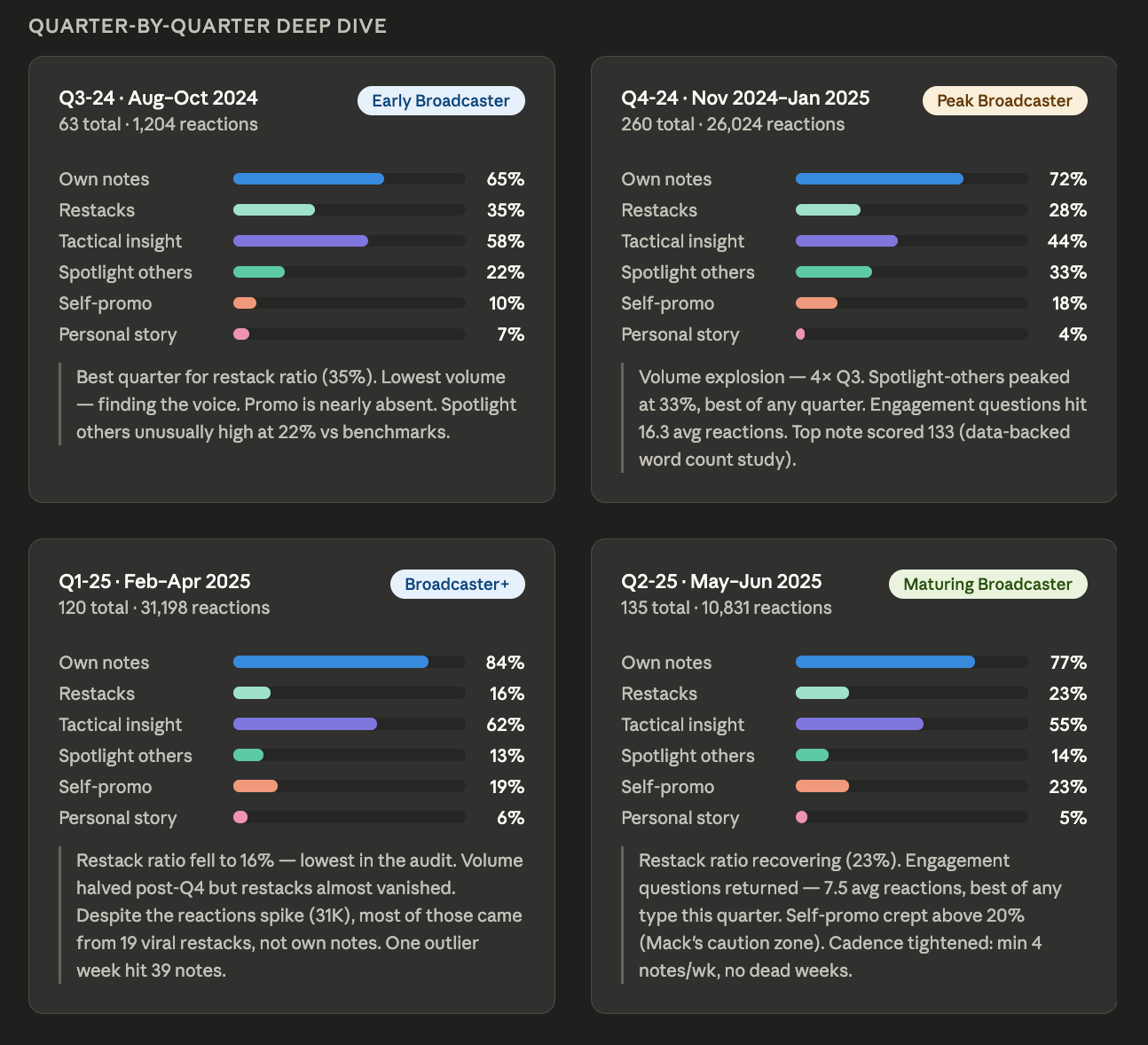
The real diagnosis came from Mack Collier’s recent breakdown of what a stagnant Notes feed actually looks like from the outside.
Three patterns that predict stagnation:
the Broadcaster (mostly self-promotion, no two-way engagement);
the Ghost Who Posts (long silences, bursts of self-promotion);
and the Surface Engager (lots of activity, generic comments).
I looked at my own feed honestly. I was running a Broadcaster pattern. Lots of original Notes going out into the void. Very little evidence of substantive back-and-forth with other creators.
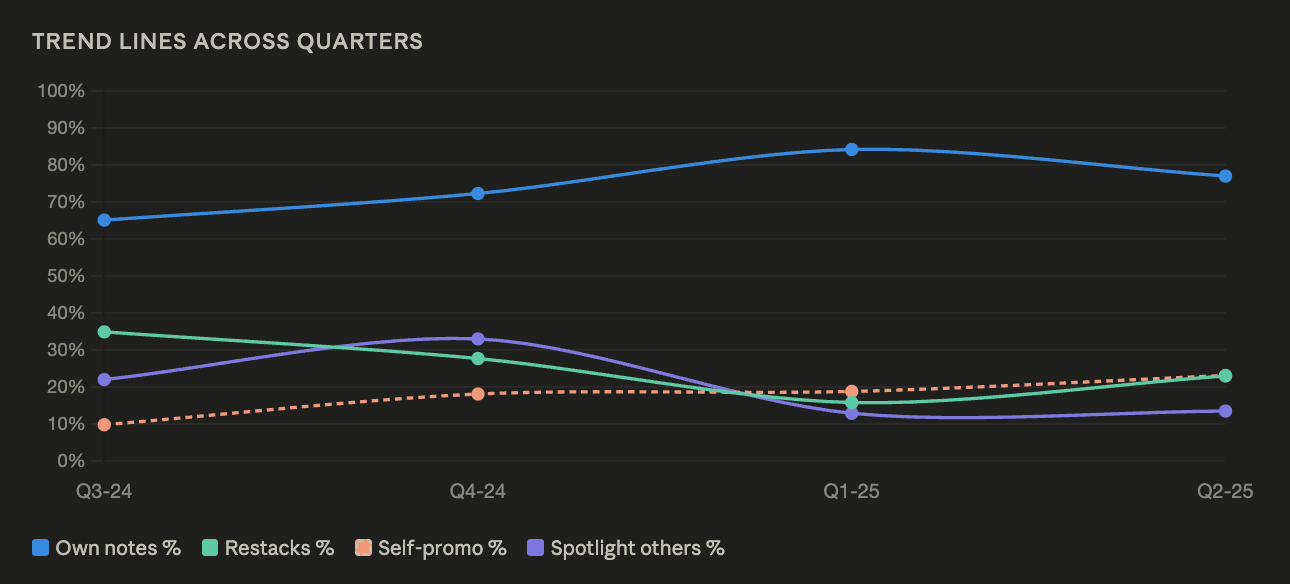
Mack’s data backed it up with something concrete: Notes where he spotlighted someone else consistently outperformed his self-promotional ones. My data shows the same pattern in a different form — the Notes that drove actual clicks were the ones where I was responding to someone else’s work or sharing a specific data finding that invited other creators to engage.
What I’m changing: before publishing any Note, spend 10–15 minutes leaving substantive comments in other creators’ feeds. Not “great post.” A sentence that adds something or asks something real. That’s the habit shift. The content isn’t the problem. The participation ratio is.
The StackContacts publication is now the growth vehicle. While Finn’sights Notes flatlined, the StackContacts publication grew 78% in three months — from 54 to 96 subscribers — with far fewer Notes pointed at it. The best-performing post in all of 2026 was a StackContacts post: “How to Say Hi to Your New Substack Subscribers” — 10 signups, the only post to hit double-digit attribution this year. The pattern there is tight product-to-content fit. Write about the workflow the product solves, link directly to the outcome, and the conversion happens. I’m expanding that deliberately.
Product-tied posts over general growth posts. Post views on Finn’sights have declined from 791 in February to around 400–500 now. The high-view posts are the ones with a specific product or tool angle. The ones that underperform are the broad “here’s how Substack works” posts. I’m shifting the content calendar toward posts that are useful to existing StackContacts users and product buyers — not posts trying to attract new-to-me readers from search.
If you were starting today with zero followers, would you build on Medium first, Substack first, or both simultaneously?
Substack first. No question.
Medium is a discovery platform. Substack is a relationship platform. Discovery matters in month one. Relationships matter in month twelve.
I wouldn’t ignore Medium — if a post genuinely resonates there, it can drive a meaningful spike of subscribers. But I’d treat Medium as distribution, not as home. Your home has to be somewhere you own the list.
If you’re purely a writer who wants readers, Medium might be faster early on. If you want a business, go to Substack on day one.
Where do you think Substack is heading as a platform, and what opportunities do you see opening up for creators?
The social graph problem is getting real. Your subscribers on Substack don’t fully belong to you — they belong to Substack’s recommendation graph.
As Substack grows, that graph becomes more valuable to the platform and more complicated for individual creators. The creators who understand their own audience data — who reads, who converts, who’s drifting — will have a significant edge over the ones who rely on native metrics alone.
That’s an opportunity for tools, not just content. The creators who are going to win aren’t the ones with the best prose. They’re the ones who treat their newsletter like a business — track the signals, iterate on what works, and build systems that don’t depend on one platform’s algorithm staying friendly.
The other opportunity: Notes are still under-used as a subscriber acquisition channel. Most creators treat them as a sidebar to their main publication. The data I’ve collected shows Notes can be a primary growth driver if you treat them with the same rigor as posts and using Mack Collier’s insights. That’s a gap. The creators who close it early will pull ahead.
Hey Lidiya
That's the best and wonderful article to make bugs out of the blogging channel
Thanks for sharing and keep writing 💫
Just highlighting this part
The writing itself wasn’t the hard part. Figuring out who I was writing for — and why — took much longer.
Can you share your articles in my community thread by subscribing me??
I give weekly Shoutouts to wonderful writers like you!!
This one is such a great read- going into my saved posts