


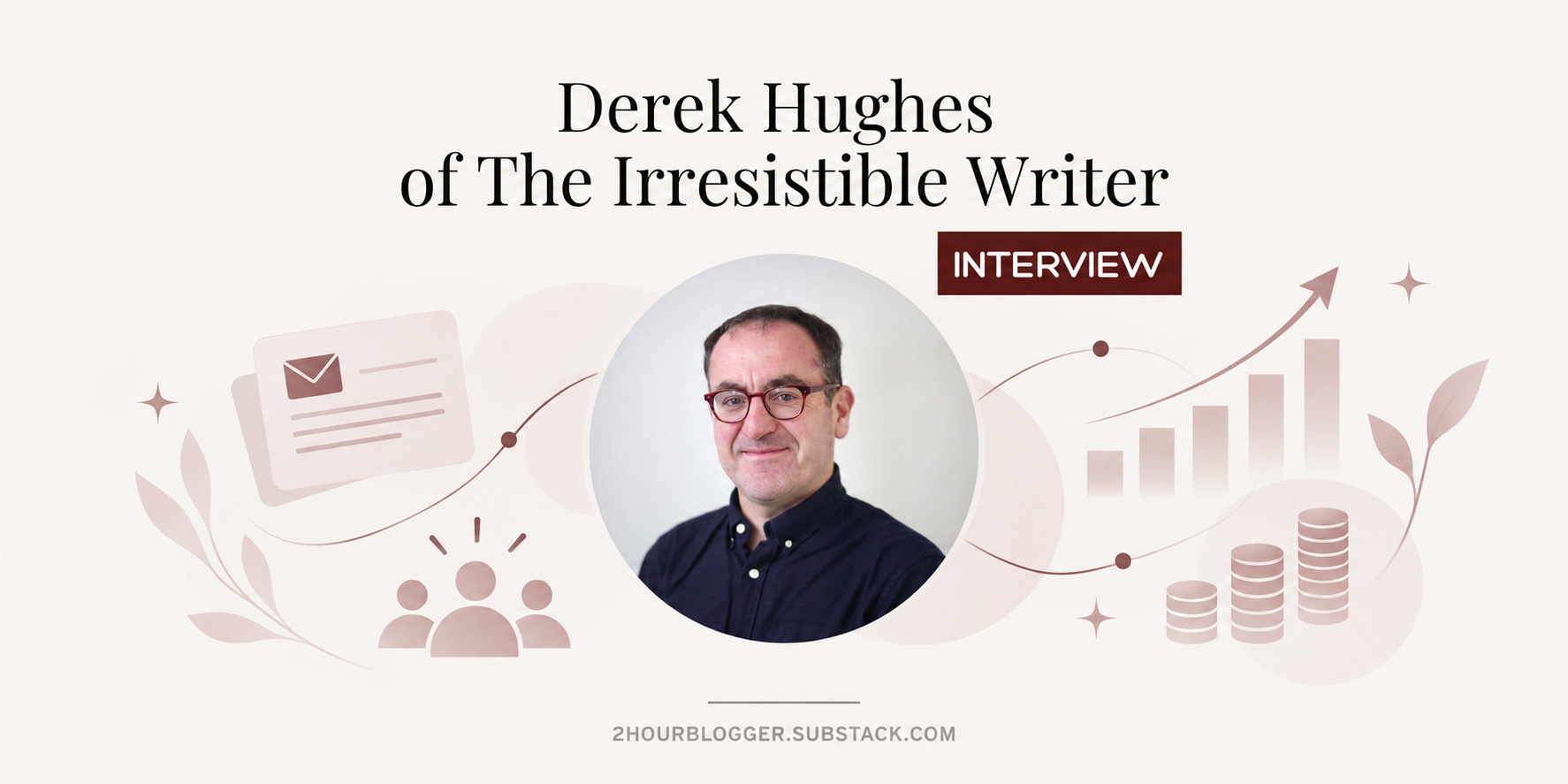
This is an interview with Derek Hughes of The Irresistible Writer.
Be the first one to hear about new interviews:
The Beginning
Tell us about your publication. What do you write about and who is it for?
The Irresistible Writer is for people with ideas who want to be seen and paid for them.
I share everything that’s worked for me in starting from scratch aged 51 to a thriving Substack, which has meant I could quit my 9-5.
What was your writing journey before Substack?
I’d been writing on Medium for about 18 months, probably half of that time with no traction at all because I didn’t have any writing or business background
So I’m all self-taught; how to write, how to gain attention, how to say meaningful things in a way that readers can digest.
And it seemed to work because I gained about 20,000 followers before moving to Substack.
What made you start on Substack in the first place?
Everyone was telling me Substack was the place to be. I ignored everybody’s advice for a long time because I always think you should focus on one platform.
But eventually I gave in and started writing on Substack.
What did your first few months on Substack look like?
I started from one subscriber in July 2024. Two months later I was at 500. By November, past 1,000.
That sounds fast written down. It didn’t feel fast. The paid tier was the harder part.
It sat flat for months with a handful of paying subscribers, one of them family.
That taught me something I still repeat: people already trusting you is not the same as people understanding what they’re paying for.
At what point did you realize this could become something bigger?
After about nine months, I’d passed the 2,000-subscriber mark, I really started to see the potential in Substack.
That was the turning point where it shifted from an experiment to a core part of my strategy.
The Growth Story
Can you walk us through your subscriber growth journey?
Two years, near enough. Real numbers:
July 2024: 1
September 2024: 507
November 2024: 1,013
February 2025: 1,944
August 2025: 4,560
December 2025: 6,234
July 2026: 8,117
The line looks smooth from a distance. Up close it’s a lot of months adding two or three hundred and wondering if that counted.
What were the biggest growth drivers?
Notes and Recommendations. They pull in opposite directions, which is why running both matters.
Notes brought strangers who had never heard of me. I stopped using them as trailers for posts and started using them as small demonstrations of how I think.
Something I’d got stuck on, and what happened when I tried to fix it. People followed the thinking first and went looking for the archive second.
The thing that changed my Notes was going back through them and comparing the ones that worked against the ones nobody touched. Same topics, same length, wildly different results. Until I did that I was guessing.
Recommendations were the bigger lever and the slower one. Most writers treat them as a swap. You recommend me, I’ll recommend you, and ideally you’re bigger than me. That approach sends you readers who signed up out of politeness and leave within a fortnight, and it makes the ask feel like a cold email.
What worked was finding writers serving the same reader I was, then spending weeks being useful in their comments before recommendations ever came up. By the time I asked, we’d had actual conversations. Some said no. The ones who said yes sent readers who stayed, because their audience already had the problem I write about.
Comments did more than I expected too, and I’d put them third. A good comment has two audiences: the author, and the reader underneath deciding whether you’re worth following. That second person is why a comment should contribute something rather than applaud.

What’s something everyone says to do on Substack that didn’t work for you?
Publish consistently and the growth follows.
Consistency without analysis is just a very disciplined way to stay stuck. I published for months before I started studying which posts actually moved people and why.
The publishing wasn’t the problem. The not-looking was.
If you had to start from zero tomorrow, what would be your first 30 days strategy?
Week 1: Get the profile and home page right, so anyone who lands knows in five seconds what I help with.
Weeks 1-4: Notes every day. Small demonstrations of how I think.
Weeks 1-4: Comments on other writers’ work, daily.
Weeks 2-4: Recommendations. Find writers serving the same reader and build actual relationships.
One post a week, tops. Enough to give visitors a reason to stay. I publish twice a week now, but that’s for an audience that already exists. In month one nobody is waiting for your posts, so the writing time goes where the strangers are.
Behind the Scenes
What’s your content creation process like today?
At the start of the month I draft out 8 post ideas. Most of the work is already done. Then I write up the posts on Tuesdays and Thursday mornings.
I write to one person with a named problem, open in their world rather than mine, and cut hard afterwards.
How often do you publish, and how did you find that rhythm?
Two free posts a week plus an easy-to-use tool for paid subs.
I used to post daily on Medium but felt that was too much for Substack.
What metrics do you actually pay attention to?
Where new subscribers come from (paid and free).
That’s it.
What was the biggest mistake you’ve made on Substack?
Launching a paid tier before I could say, in one sentence, what someone got for the money. I assumed trust would carry it. It didn’t. It sat there for six months.
The Business Side
How are you currently monetizing your writing business?
Four ways, in order of size:
A 3 month personal coaching programme for those serious about Substack growth;
6 session cohorts (Substack Growth Map, Paid to Write);
Personal Substack Audit;
VIP membership ($149 for twelve monthly masterclasses, which sits on top of the standard subscription rather than replacing it);
Standard Substack subscriptions ($45 a year for a new tool every Monday).
The Substack subscription is the smallest line by revenue and the most important one by function. It’s where people find out whether I’m worth paying for.
What role does your newsletter play in your overall business ecosystem?
It’s the whole thing. The engine, rather than the advertising for the engine.
Every coaching client I’ve had came through Substack. Not from a sales page. From a post, then a Note, then a comment thread, then a DM.
The newsletter is where people work out whether I understand their problem. By the time anyone asks about coaching, the selling is already done.
Can you share a rough range of your monthly or yearly income?
Somewhere in the region of $60,000-$80,000 a year. Usually work around 3 hours a day.
What kind of content actually converts readers into paid subscribers for you
Posts where I take something apart in public.
My best paid converter this year was “I Compared My 100 Best Notes to the Flops.” I’d gone through a hundred Notes to find the one thing that hooked readers, then built a tool from it. Ten paid upgrades off one post.
What converts is a piece of work someone can see I actually did, and would never do themselves.

Which product has been your biggest success, and why do you think it resonates?
Personal Substack Audit. People are tired of courses and content. An Audit applies all my framework to their Substack. Their home page, posts, Notes. Shows them exactly what they need to rewrite (and what to keep). Plus I give them 5 rewritten examples so they know what to aim for.
One buyer put it better than I can:
“As a solopreneur I’ve spent a lot of money over the years. This is easily the best $99 I’ve ever spent.” John McLean
Many writers believe they need thousands of subscribers before they can sell something. My first product made $2,500 with just 585 subscribers.
What do they get wrong about monetization?
Building trust before they launch.
People need to be convinced they are the obvious choice before you even try to sell anything. You build this through telling stories, revealing your process and providing plenty of evidence. Even your failures create a connection so people will trust you.
It’s sad to say but there are plenty of charlatans on Substack faking their results and overpromising.
Can you walk us through how a single Substack post eventually becomes part of a paid product?
It starts as something I’m stuck on. I work it out for myself, write the post, and watch what happens in the comments.
If the same question keeps coming back underneath it, that’s the signal. The comments stop saying they liked it and start asking the same question again. That gap is the product.
The Notes analysis is the clean example. Post first. Same question kept arriving. So I built the tool that does the thing the post could only describe.
Besides comments, where do you look for product ideas?
DMs, mostly. People tell you things in a DM they’d never put in a public comment, especially the embarrassing version of the problem.
After that: my own coaching calls. If I explain the same thing to three clients in a month, that’s a product asking to exist. And my own stuck points, because whatever I had to solve for myself this year, a few thousand people are solving badly right now.
What’s Next
What’s your goal for the next 12 months?
Fewer people, further in.
I’ve had the big numbers in views and subscribers and I enjoyed them. These days the part of the week I look forward to is opening a client’s publication after six weeks and seeing that they’ve rewritten their home page and it’s working. That’s a smaller thing to report than a subscriber count, and it’s what I want more of.
What are you currently experimenting with?
Reshaping the week around the one-to-one work rather than fitting it around everything else.
The Audit has turned out to be the useful filter. Someone buys a $99 audit, I go through their Substack properly, and by the end of it both of us know whether there’s a bigger piece of work worth doing together. That beats a discovery call where we’re both guessing.
Where do you think Substack is heading as a platform, and what opportunities do you see opening up for creators?
I know what won’t change. Being able to help a specific reader solve a specific problem. If you can do that you’ll keep growing and making money. Regardless of what whistles and bells Substack adds (or removes).
This is helpful. Thanks.
This was really great. I love Derek’s strategic, simple approach to Substack! Thanks for this interview!!