

I started on Substack 6 months ago with 0 subscribers. And this is how things look like today:
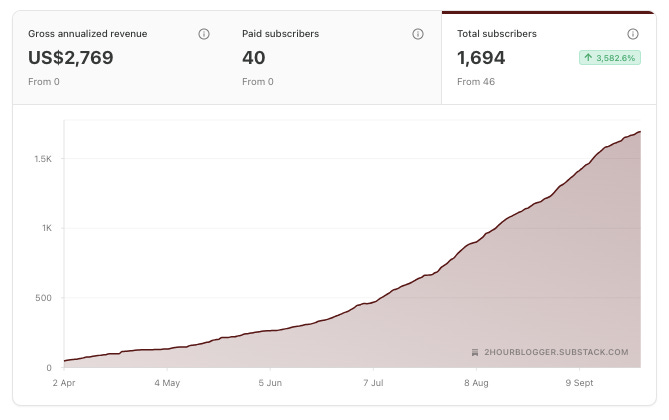
The truth is that reaching that number only made me think back on the first 100.
Back then, I knew nothing about Substack. Now, I know something about it.
The experiences have been completely different, and I’m a totally new version of myself now than I was half a year ago.
And that journey was necessary. There wasn’t a viral moment or anything like that, and I’m actually happy about that.
Why?
Because virality can lead to being overwhelmed, and it can bring either no subscribers or totally wrong ones for your publication. I don’t want that.
I also hear they unsubscribe pretty quickly.
All this can distract us from what we’re actually building here - a scalable business that provides real value to the right readers.
So, in those first months on the platform, I built some new skills, set some boundaries so all this doesn’t consume me, improved my positioning, focused on relationship building, built a specific mindset, and doubled down on the things that actually work for me and which I enjoy the most.
So I decided to write about that - what nobody tells you about the difference between getting your first 100 subscribers, and your first 1,000.
Because the difference is massive.
The 2 milestones required completely different things from me, so let’s talk about it.
Hopefully, this article reminds you that it’s okay to be at any stage of your Substack journey, that comparison is a distraction, and that you will get where you’re headed, but you can also relax knowing you’re building the necessary skills on the way.
And the final section of this post is priceless :)
Getting the first 100 subscribers
When you’re just staring out on Substack, nobody knows who you are, you are still figuring out your positioning, and every subscriber feels like a big deal (to the point where you might refresh your stats all the time to see if you’re one number up, or - God forbid - down).
You probably rely more on personal outreach, Notes, networking, etc. And you are learning what people responded to.
The first 100 readers are about getting noticed and finding your people.
It took me 1 month to get my first 100 subscribers.
Here’s what I focused on during them:
I turned Substack into my main platform and left most of my other business activities behind.
I turned it into a daily thing - I was showing up here every single day, reading, learning, engaging, commenting, posting Notes, and posting my own content (first, it was on blogging topics, Substack Growth came later when I had something to share.)
I felt the support of the community and I was actively cheering on others. I was very careful with the energy I bring to the table. I made sure to only look at other people’s business and wins if I see it as a possibility for me too, and not to compare in a way that makes me want what they have, or feel behind.
And in this post, I outlined the EXACT things I was doing in those first weeks on Substack. I’ll share a summary below:
Notes.
I was posting on Notes daily, and I believe that made a difference.
I knew from many experts that Substack is pushing Notes right now.
Notes can also be quite general, but it’s never a bad idea to stick to your niche and teach what you’re best at. Give people quick wins and they are more likely to subscribe to learn more from you.
Engagement.
Substack is also all about engagement, and that’s why it was part of my daily Substack ritual.
By engagement, I mean:
Checking my new notifications and reacting on them;
Engaging with the accounts who liked my content;
Leaving meaningful comments on some of their Notes or posts;
Whenever I actually read someone’s post, I definitely left a comment;
Also, I would see content from people who aren’t in my community and randomly engaged with a few posts (I just went with the flow, there was no specific strategy there);
I followed other people;
Some publications I was subscribed to have subscriber chats and there are often invitations to share our latest Note or Post and engage with a few others, so I did that all the time.
Big chance the new followers and subscribers are fellow writers and creators, though, and not people who actually want to learn from you or who will become paying subscribers when you start charging. So keep that in mind.
Posts.
I also started publishing a lot. I hosted a free blogging challenge, which seemed like the right first thing to do on the platform to build some credibility around my topic.
I wouldn’t say these posts contributed to my growth, though, and there wasn’t much engagement. But I came here for the long-form content, and at the time, it was related to the blogging category.
I learned a lot from actually posting articles here and seeing how it goes, as well as reading a lot from others.
In terms of mindset, you can check out this post I wrote a long time ago:

I talk about the importance of having the right people on your email list, not just anyone.
And here’s something I shared then, which I still stand by today:
“This is your reminder that chasing 100 subscribers isn’t really your vision, it’s just a random number and something many writers want when they first start out on Substack. But once you’re there, it’s really nothing.
But at the same time, it’s everything.
100 people said Yes to you, you have access to them, and can form relationships.
Realistically speaking, each of them might convert into a paid subscriber in the future even if they weren’t interested in the topics you cover, or didn’t think they’d ever pay for a publication.
But if you find the right angle, create the most helpful content, and really offer big wins with your paid posts, anyone who finds you and subscribes for free, might later be tempted to check out your exclusive content.
So both of these are true at the same time. Take this milestone seriously, but at the same time - don’t take it too seriously.”
What’s next?
100 people are watching. Time to post better Notes, write better newsletters, and create a Substack strategy you’ll stick to.
Getting from 100 to 1,000
Three months later, I reached 500 subscribers (with 2 paid ones).
By then, I had learned a lot more about how Substack works, was engaging for hours daily (still!), wrote a lot more content, had started interviewing others, covering Substack growth and what works for me (which, of course, makes growth on the platform easier), and had turned the paid tier on.
I was treating Substack like a business. I never stopped being consistent with articles and Notes, engagement and learning from experts.
All this pays off.
I was also improving my positioning month after month, more and more readers were sharing what exactly they like about me and my content and that gave me an idea of how my brand here is being shaped and how I can serve people even more.
I was publishing paywalled content even if there weren’t many people to read it yet. I was clear about what’s free and what’s behind the paywall, and in the following months that became even clearer.
Here are some of the things that worked well for me in the next stage:
Engagement - THE thing to do on Substack daily. You’ll get rewarded. The more I engage, the more my publication grows. It was a few subscribers a day, then around 10 a day, and now it’s 15-30 a day. It’s totally possible.
Passion - In business, I always go after what I’m passionate about. And this platform, the topics I cover, the people I connect with here, the business model, my next moves - I’m truly passionate about it all. That helps me show up often, with the right energy, and not see it as work, but as this fun project that I’m turning into a business.
Speaking of which…
Treat Substack like a business, not a hobby. Even if you aren’t earning from it yet. That mindset changes everything. And no, it doesn’t mean to treat every interaction here like a transaction, or to write every single comment and message strategically. There’s a way to do it authentically and show up fully, and yet to always be going in a certain direction with your writing business.
Write more of the posts and Notes that work well. - It might not be always the ones that are your favorite or easiest to write. The engagement and feedback tell you what to double down on.
At the end of July, I reached 700 subscribers, had 5 paid ones, and made a few other big moves, such as:
Starting the publication Chat (which is now a big part of the community here);
Providing a lot of value in the DMs, in comments, in my articles, and in my Notes (that continues. It’s always been the goal!);
Still spending hours daily on the platform (now it can be less and the boundaries are stronger).
The next milestone I shared was 900 subscribers. I still never got viral, never did sub for sub, and wasn’t asking people to subscribe to me.
I let the content do the work for me.
At this stage, I was:
actively talking about my paid tier;
writing about the questions people asked me;
working on my paid offers;
doing audits for people and giving them massive value;
publishing monthly Substack growth reports and sharing everything happening behind the scenes of my business;
engaging with new writers all the time;
being helpful with tips and opinions when I can;
maintaining relationships with the creators we connected with;
cheering on others’ wins;
publishing interviews with other writers.
And then the 1K milestone was reached:
The biggest differences
Content creation
At 100 I was wondering what to write about, wasn’t sure if it would resonate with people here, and didn’t have any real feedback to work with.
1,000 subscribers later, I knew exactly what my audience needed from me, what content worked well here, what I enjoyed the most, what came easily to me, and where the potential lied. So I did that. It was a win-win.
Boundaries
My mindset in the beginning was more like ‘Let’s see what more I can do.’
They say that business ideas are like throwing spaghetti on the wall and seeing what sticks. I had to test a lot, see what works and what I like, what I continue doing and what simply isn’t for me.
I wasted a lot of time on things that didn’t move the needle forward, but that’s quite normal. Also, I could have taken action sooner in many ways, but I did what I could at the time.
Now, the mindset is: “Does this help me move the needle forward, provide value or give me joy? If not, I won’t do it.”
My boundaries are stronger than ever, so the platform doesn’t drain me.
Monetization
I started by building an audience and seeing how Substack works, and making decisions along the way. I knew I’d turn the paid tier on, but I needed to be confident in that decision. And I only added a Founding tier this month, after I had reached 1,400 subscribers or so.
At 1,000, though, I was opening with this in mind: How can I restructure my paid tiers so growth is sustainable?
100 changes how you see yourself as a writer. 1,000 changes how you see your writing as a business.
Metrics
At 100, every new subscriber and follower counts.
At 1,000, you know you only need the right people. The ones who engage with your content, open your emails, are interested in your paid tier, are part of the community, and like how you write.
Going from 100 to 1,000 isn’t just doing more of what you did before. It’s figuring out what’s worth doing more of.
At this stage, you have to become more intentional about your:
Content pillars/Recurring topics
Foundational content
SEO/Search intent
Collaborations
Content that leads naturally into your products
I review all this in The Substack Growth Audit, by the way. It’s available for Founding members.
Want to go deeper?
I share practical strategies for growing a Substack, from getting discovered and building an audience to turning readers into paying subscribers.
If you’re serious about growing your publication, join the paid tier for more in-depth strategies, behind-the-scenes lessons, and everything I’m learning along the way. Here’s what you unlock as a member.
What Got Easier
Now, I know who I’m writing for. I know what my paid tier delivers. I know where I’m headed and have more content ideas in mind than I have time on my hands.
I love interacting with my paid members, and the weekly Q&A thread in the chat I have for them turned out to be really valuable.
I have multiple conversion points, my publication is designed to invite free subscribers to take a look behind the curtain, and once they do, they are welcomed and delivered even more value.
Content creation is easy now because I do a lot, so I have a lot to write about (detailed breakdowns and case studies are coming for paid members). I also get a lot of feedback from you guys in comments or in the DMs, and that confirms I’m on the right path with the topics I cover, but also gives me many things to write about next.
In the beginning, I didn’t know where my next subscriber will come from.
Now, I know. There are many possibilities daily.
Such as:
from other publication Chats I’m active in;
they can see my chat threads and subscribe because of that;
from any article I’ve published and that someone restacked;
from a Note (old or new);
from a recommendation;
from the interviews I publish with other creators (they share it with their audiences too);
from my features on other publications;
from word of mouth (if someone found my content helpful, they can tell others about it or just share my profile with them);
from a leaderboard I rank in;
from search engines (when they discover an article of mine that ranks);
And more.
What Got Harder
Keeping everything I’ve created and am about to create organized.
Keeping up with DMs and notifications.
Continuing to send a personal Welcome message to new subscribers as the numbers grow.
If you haven’t considered Welcome messages yet, I wrote all about it in this post:

Finding balance between free vs paid content.
Having a clear customer journey.
Making sure paid members can find everything they need.
At 100, you might obsess over:
“Why am I not growing faster?”
At 1,000, the question becomes:
“How do I build something sustainable from this?”
The biggest takeaway here is this: You don’t need to wait until 1,000 subscribers to start thinking like a creator with a business.
The things that help you get to 1,000 are often the things that help you build beyond 1,000.
Don’t give up because the first 100 took you longer than expect, or because your journey was harder and longer than those of others (you’re walking different paths in business).
I hope this gives you hope to keep going.
Next, behind the paywall, I’m breaking down the 8 things I’d prioritize if I were starting from 0 today, based on everything I’ve learned getting here.
If you’re serious about growing over the next few months, this is the section I’d save and come back to.
What I’d do differently if I were starting from 0, knowing what I know now

Let’s dive straight into the strategies. One of them is pretty controversial, and something I haven’t seen anyone else talk about so far, but it’s worth mentioning as I think it can be a game-changer.
This is basically what the Substack Growth Audit is all about, so if you got that already, this will serve as an important reminder.