



This is an interview with Nelle of Mama's Homestead.
At a glance:
Current subscriber count: right at 3,700
Most successful post: It’s hard to choose which one, but The Grand Tour: An Invitation to Walk the Homestead With Me was the beginning of a series that has given people a reason to come back each week.
Most underrated growth tactic: Notes, Patterns in Notes, Related Notes. Be genuinely responsive - talk to your guests. Visit other creators and engage with their content. I see Substack as a long conversation.
Favorite Substack feature: Analytics, to track how well a note or article did, but I don’t get too caught up in them. I recently discovered - Top Collaboration Opportunities, where creator matches show you the Substack publishers whose audiences and yours cross over the most.
One creator everyone should follow: Lidiya - She is very responsive, personable, and helpful. In my space, Huw Richards - experiments and teaches how to grow lots of food on a small property.
One tool you can’t live without: I hate to call my husband a tool, but he is my main picture picker and he pretty much built everything on our homestead. Oh! You meant on Substack, well I like how easy it is to write an article. I have blogged for years and nothing is this simple.
Key metric to track: Comments and engagement
Main revenue source: Affiliate links, for now.
One sentence describing your newsletter: Mama’s Homestead is a weekly invitation into a 19th-century way of life and beyond, the skills, the table, and the stories worth passing down.
One piece of advice for new writers: One piece that all links together = Choose 3 pillars of focus to write about and if the content doesn’t fit in one of those pillars, don’t write about it on Substack. Use this to build trust and a little world/tell a story and invite others into it. Make your content bingable. Create interest clusters. Tell your reader where to go next to continue the story. Don’t treat Substack like a diary.
The Beginning
Tell us about Mama’s Homestead. What do you write about, and who is it for?
I write about timeless skills for a modern homestead.
Today, I teach homesteading and simple skills - food preservation, herbalism, gardening, cooking, baking, crafting, sewing, home organisation, and more - through hospitality, in-depth workshops, classes, and public speaking. I love inviting people into my world.
I live on a homestead modeled after that same 19th century way of life, with just enough modern touches to make it livable: a wood-burning fireplace with a cooking crane, a cast iron wood stove, a root cellar, a timber frame barn, an orchard, a greenhouse, grape arbor, and herb and vegetable gardens that would have looked familiar a hundred and fifty years ago.
One example: I teach a class where people churn butter in a mason jar and go home with a loaf of bread they made with their own hands. I’ve taught it many times now in different towns, and every time, a few people come back months later to tell me they still make that bread, some have taught their own kids the butter, jar and all. I love this!
My newsletter is where I bring all of that to you, wherever you are, through my 3 pillars.
Rooted: Practical skills and seasonal rhythms of a life tended with care.
Gathered: Homestead hospitality, and the nourishing that happens around a table.
Passed Down: The legacy we leave through stories, recipes, traditions, skills, and the person we become as we pass them on.
You grew up on an 1830s homestead and almost left that life behind. Can you tell us more about that journey?
I grew up in a house that was a documented stop on the Underground Railroad. You could tell just from how it was built.
My parents ran it like a working 1830s homestead, and two sets of grandparents lived the same way on their own properties. It was like going back in time. We fed and watered animals and gathered eggs before going to school and did the same thing when we got home. We worked in the tobacco fields all summer and more (tobacco was a year-round crop), raised a garden and put up the harvest every year, made some of my own clothing and quilts. I learned how to cook, bake, and decorate cakes. I learned how to build things and fix things.
I was in 4-H and FFA (sewing, cooking, baking, and farm projects, like showing hogs and crops at the fair). I took vocational agriculture my freshman and sophomore year of high school, then fashion and interior decor my junior and senior year.
I went to college for fashion and pursued a career in that field.
I didn’t see the unique opportunities I had at a young age.
It wasn’t until I had my own kids and started homeschooling them that I understood what I’d actually been given, and that if I didn’t pass it down, it would end with me. That’s really where Mama’s Homestead started, long before it had a name.
What made you decide to bring these timeless skills and traditions online?
I think they are slowly dying away in our modern world of technology. People are longing for stepping away and working with their hands and with the land and animals again. I think that’s good and I’m happy to help them start or work and learn alongside them.
I want people to fall in love with slow living, homesteading, simple hospitality, and building community.
What was your writing journey before Substack?
I’ve blogged since 2010, before Substack existed. The tools on Substack are easier to use than other writing platforms. It makes it truly enjoyable to tell your story rather than fighting with a tool.
What made Substack feel like the right home for Mama’s Homestead?
How simple it is to actually write and share on one platform. It has the articles, social media, and more in one place. Notes and articles give me a way to talk with people, not just publish at them which is closer to how I actually teach in person.
The Growth Story
What did your first few months on Substack look like?
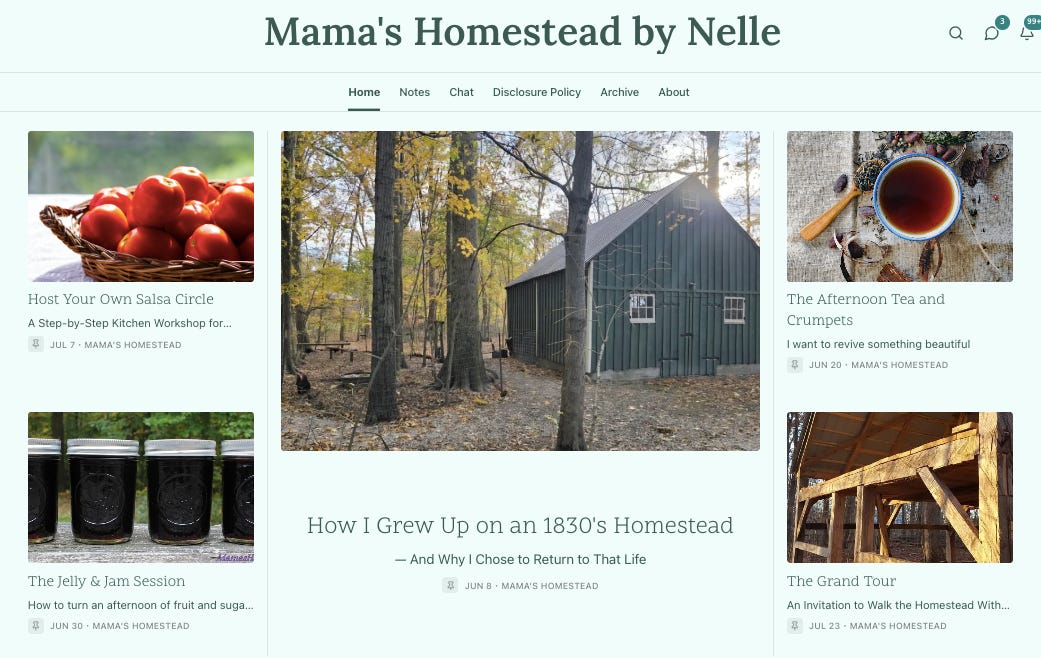
I posted my first article on Substack on June 8th with the goal of telling my story and building trust with readers.
I started posting every day and I didn’t pay much attention to the numbers, because they were small.
I tried to create as much value as I could for my readers.
You went from around 385 subscribers to 2,000 in less than two weeks. Can you walk us through what happened?
I crossed 100 subscribers on July 13th and that’s a big milestone. Then my subscriber count started climbing pretty quickly and plateaued at 385 on August 1st.
I decided to find out why they took off and discovered that one note was getting more attention than the rest. I wrote a similar note and it took off and took me to over 1,000.
I was at 1,400 by August 16th, August 28th, I hit 3,000.
I did notice a pattern - that guests would like that note, like another couple of notes, maybe an article, follow me, then subscribe.
Tell us about the Note that took off.
The note that took off is one that brings others into my little world. It’s relatable.
I think people want to learn the things on the list or already know the things on that list and want them passed down. I teach these things and more.
What were the biggest growth drivers?
Notes/Related Notes and My Homestead Tour + Linking posts together to create binge reading, like a television series. This is life from your angle/perspective.
The Homestead Tour takes you through everything that makes up Mama’s Homestead: what we’ve built, what we do here, how we involve others and build community, and I even talk about our Thoughtful Spots (inviting places on our property where you can slow down and relax).
What kinds of Notes bring you the most subscribers, and what patterns have you noticed?
Nostalgic notes that tell a little piece of what Mama’s Homestead is about (bringing back timeless homesteading skills - a movement, maybe)
What’s one thing you did during this growth period that you think other writers could learn from?
I kept going back to my 3 pillars of focus. If it didn’t fit, I didn’t post it.
This makes you more relatable to a specific reader and will boost your other content up to the related content feed. This helps you find your people and helps them find you.

Behind the Scenes
What’s specific about the Home & Garden niche on Substack?
It’s a generous space where writers aren’t guarding their readers. They send them to each other.
I’ve learned a lot from genuinely engaging with other homesteading and home-and-garden writers.
I get to see what homesteading, gardening, cooking and preserving, and hospitality, looks like in all parts of the world. It’s a great community.
How do you balance practical content with the more personal and reflective side of your writing?
Workshops and hospitality bring both the personal and reflective together. Inviting others into your story, like inviting them into your home(stead). I am a teacher at heart, but I also love to host.
Real life experience: I teach homesteading, cooking, and home organization classes/workshops locally and love when people jump in hands-on and learn a new skill.
Often, I’m the one learning. My guests usually know more than I do about the topics I teach and I learn from them.
For example, I have even spoken/taught in Amish country to the Amish people, talk about a humbling role reversal.
How often do you publish, and how did you find that rhythm?
I try to publish 2-3 notes every day.
I publish an article at least every Thursday morning.
I try to get 3-5 articles spread throughout the week, no more than 3 emails, because I don’t want to fill inboxes.
I started with publishing once per week, because I didn’t want to feel overwhelmed. Most of my content is seasonal and I want to get it out as quickly as possible, so I’ve slowly picked up the pace.
How much of your content comes directly from what you’re doing on the homestead?
All of it! The cooking, baking, preserving, gardening, hospitality, homesteading skills, the classes and workshops. The timber frame structures and infrastructure my husband built.

Has your sudden growth changed the way you think about your content or publishing schedule?
I want to give more! It makes me want to serve my guests and grow trust in this community. They came for a reason and I want to give them more of what they came for.
How do you stay connected to your original mission while thousands of new people are suddenly discovering your work?
By staying with the three pillars: Rooted, Gathered, Passed Down.
Every piece I write has to fit one of them, or I don’t post it. As long as that’s still true of what I’m writing, the size of the room doesn’t change much.
The Business Side
You recently got your first paid subscriber. What did that feel like?
Exhilarating! Free growth tells you people like what you’re making. A paid subscriber tells you they trust it enough to invest in it.
I’m still building the Hearth Circle and I want to make it worth every penny and more for my readers and serve them the best I can.

What kinds of paid content or experiences are you most excited to create?
Deeper access into the actual work of the homestead. Gathering Guides (hospitality kits) tied to the workshops
I already teach in person, so people who can’t get to Ohio can still sit at the table. Homesteading/Hospitality Journals.
Could you see paid subscriptions becoming a bigger part of your business, or will Substack remain one part of a larger ecosystem?
Right now Substack is one piece of a bigger picture. Affiliate links are still my main revenue, for now. But I’d like that to shift.
I’d rather be paid directly by people who value the work than lean on affiliate income long-term. I just want to earn that slowly and honestly, not rush it.
What kind of free content do you believe is important to keep free?
The story. The Homestead Tour, the essays, the “why” behind what we do, that stays free.
I don’t want trust to be behind a paywall. What I charge for is depth and access, not the invitation itself.
What’s Next
What are you most excited to build next for Mama’s Homestead?
Finishing the Homestead Tour and building out the Hearth Circle so it feels like a real gathering place, not just a subscription tier.
I plan to bring more of my in-person workshops, the bread and butter class, cast iron cooking classes, more food preservation, and more to readers who’ll never make it to Ohio.
I also have a Layered Homesteading Workbook that takes you from being a beginner/medium to an experienced homesteader one layer at a time, no matter where you live.
And a Hospitality/Gathering Guides, Conversation Journals, and Conversation Basket Cards for people who like to host guests and build community.
I’m working on creating children’s books that teach homesteading skills with a story and hands-on activities.

What’s one thing you hope readers understand about growing a newsletter that you wish more people talked about?
Be consistent: in posting and content. Keep going.
Where do you think Substack is heading as a platform, and what opportunities do you see opening up for creators?
I think it’s becoming less about broadcasting and more about building community. The opportunity is for writers willing to be present and engaging in many ways. It feels like a slow conversation.
I love this look into a different corner of Substack!! We get stuck in such a bubble that seeing what’s happening in Home & Garden is such a breath of fresh air. Maybe I need to go explore more often 🤔
This is a very interesting story, far outside my usual topics.
I like reading something like this now and then.
Such strong growth in just a few months seems crazy to me.
But Nelle has been blogging for so long that it makes sense.
I wish her continued success in building her community.