
No, I Don’t Think Substack is Collapsing.
The goal is bigger than paid subscriptions: here's a more optimistic view of building on Substack

I saw this article circling around, but only actually read it when a reader shared the link and asked for my thoughts on it.
I ended up responding with a long comment, but this got me thinking that maybe more people would like to hear a more positive take, so this is it.
Just a heads up: I don’t know the writer of the original piece. He seems to have a great online presence and to know his stuff well. Also, while I’ve been a blogger writing content online for a decade, I only joined Substack this year, so I haven’t personally experienced the changes happening on the platform.
I’m in no way comparing myself to other creators. This is just a short post to share my opinion, to discuss the business models behind everything we do online, and to give you some hope.
If you haven’t read the original article yet, please do so:

In a nutshell, the author argues that Substack has shifted from a reader-supported writing platform to a social media one chasing engagement, and this leads to paid subscriptions stagnating due to subscription fatigue. He believes this has made it harder for independent writers to earn a living and that Substack missed the opportunity to strengthen its subscription model and might be repeating the same mistakes as other social platforms.
(That’s how I understand it. Please correct me if I’m wrong).
I want to add another voice to this conversation.
That’s just one perspective (of a journalist, and they have a different background than most people) and it’s a rather negative one.
If we read someone else’s opinion about Substack and the creator is thriving right now, we’d immediately feel hopeful again.
That writer has seen Substack become worse than it was before, and that’s okay. But I, for example, arrived here with fresh eyes only this year to discover this wonderful place of supportive and like-minded people who would pay others because they want to, not because they have to.
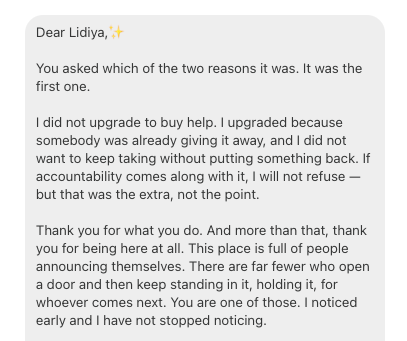
In fact, I just saw another example of this yesterday, when a subscriber upgraded to paid. We’ve had chats before, and after I saw them upgrading, I wrote a quick message to thank them and added this:
“Not sure if the reason was to just support my work, or to get some help and accountability for growing your Substack.
In any case, I hope you find value thanks to that. The chat is always open for to discuss anything ☺️”
I said it because I didn’t think they are interested in my content or Substack growth in general, so I wanted to clarify that (and if they are, to remind them that the annual paid tier goes together with a Substack Growth Audit I’m offering).
As it turns out, it’s the first reason, and here’s what they said:
I don’t know of any other place like this on the Internet right now.
The goal is bigger than paid subscriptions.
It was clear for me early on when joining Substack that paid subscriptions are not the final goal in terms of monetization. Every big creator I studied admits that most of their revenue comes from either digital products or offering services like coaching. And let’s not forget brand partnerships and affiliate marketing.
Here’s what Ana said about this, for example:
This isn’t a new business model, Substack just makes it easier than other platforms to get known for your writing, to build trust, to get paid subscribers who support your work.
What I’ve personally seen this and last year is big creators and entrepreneurs (some I’ve followed and learned from for years) who stopped using social media and started writing on Substack instead, and they brought their existing audience with them. That’s brand new readers coming to the platform, who will also find other writers and will become paid members of some newsletters.
What do you think about that?
And here’s the most important point I want to make here:
Selling an offer goes beyond turning paid subscriptions on.
I’m all about overdelivering in terms of value.
When you make your annual paid tier so good that it’s a steal, people will subscribe. The goal was always to inspire readers to subscribe annually instead of monthly because that’s when you can really help them in a way and deliver enough value for them to stay another year, and another.
The monthly supporters might cancel soon after based on how they feel about the content you posted on a specific month.
Your paid tiers are offers you make.
Maybe part of the big changes happening is that writers who’ve been around for a long time still expect to keep publishing content and lock some of it behind a paywall, and keep getting paid for that.
But it’s possible that Substack is now starting to resemble a digital product business more than a writing one, so you have to have a content strategy in mind and a clear monetization path, to add extras to the paid tiers and bring the paid member on a journey from your low-priced offers to the higher-priced ones.
And all this can be done in a genuine way.
I’ve seen all kinds of creators who get paid members in their tiers.
But the work doesn’t stop there.
This is a membership business model too, and that means constantly working on 3 things:
getting new free subscribers/growing your audience;
getting new paid members (converting free to paid ones);
providing enough value to existing ones so they remain subscribed.
And finally…
Scarcity vs Abundance
The author of the article also said this: “Without a bigger pie individual Substack creators are instead forced into direct competition with one another. The only way to grow is to pillage the paid subscribers from other creators.”
I don’t think that’s necessarily the case.
We live in an abundant Universe. There’s more than enough for everyone.
I stopped seeing anyone as competition in business many years ago and that was very liberating.
Here’s why:
Someone earning in the same niche or from the same business model is simply proof that what we’re creating is monetizable. They’ve already found people who pay them for their product or service, and one more person entering that market doesn’t take anything away from them.
Even if people stop paying one writer to pay another, that says a lot. The readers found someone who was a better fit, or more relevant right now, who can help them more or whose content brings more meaning to their life.
We all talk about impact with the work we do - well, this is it.
Let people go where the biggest impact for them is. That’s how lives are changed.
At the same time, the writer who ‘lost’ paid subscribers can either be okay with it and focus on delivering even more value to their ideal readers, or check if they aren’t missing something in the way they deliver their work, the depth of their content, or the transformation they provide.
And yes, I’m aware that when talking about content, I always mean educational content, helping people with your written work, offering them transformations and solving their problems.
This is what I create, and this is what I consume, so my mind always goes there.
But anyone else can also have strong reasons to keep getting paid subscribers, they just need to find their unique angle, get feedback from actual subscribers, and always strive to do their best work.
What is competition?
There are others who write about the same things, teach a similar framework, are more experienced, and know how to market themselves better.
But they don’t have your unique experience and perspective, or your way of expressing yourself. Their writing will never be like your writing.
You bring something unique to the table.
Maybe it’s your energy, maybe it’s the confidence, maybe it’s your stories and the way you tell them, which leaves such a strong impression on others that they just can’t stop reading.
Whatever it is, it’s your superpower.
You just need to adapt to the ever-changing online world.
So, the question here is:
If you want to run your writing business on Substack, are you willing to evolve together with the platform?
What do your paid tiers actually bring to the table to not just encourage people to subscribe, but to stay subscribed?
You’re not just a writer anymore.
You’re growing a newsletter business, a subscription-based business, and probably a digital product business.
There are many moving pieces, and only you know what deserves your attention.
The writing itself remains. This is who you are and this is what you do. But everything else changes, and we need to adapt.
What do you think?
Keep building your writing business, one post at a time!
Lidiya
I’m so glad you wrote this Lidiya. That article, wrong or right, completely stopped me in my tracks and made me question everything 😩. I think it’s important to recognize that it’s an opportunity to evolve here instead of give up!
I’ve not felt anything except positivity since I joined in April. I’ve found Substack to be a supportive community, where fellow writers are willing to help each other, see each other grow, and excited to collaborate on grander projects.
I love Substack, and can’t wait to see how it develops!