
How Comments Helped William Grow His Newsletter to 2,000 Subscribers
William Leroux built Become Better You with his Comment Method, proving that real conversations can outperform chasing algorithms.


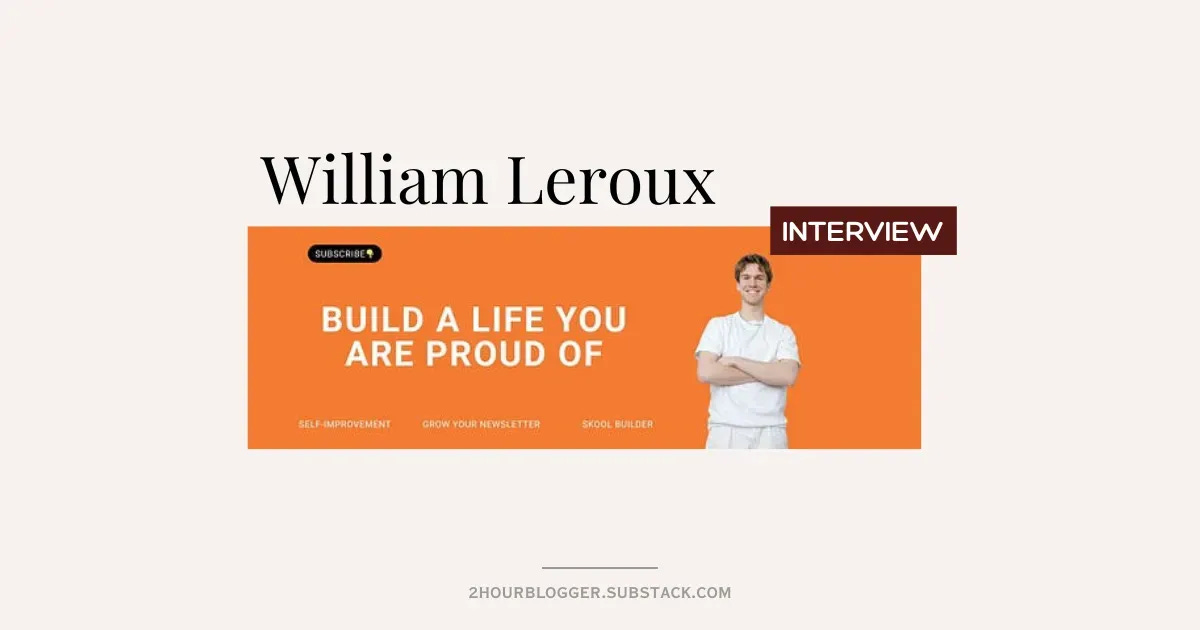
This is an interview with William Leroux of Become Better You.
At a glance:
Current subscriber count: 2100
Most successful post: No, you don’t need to post 5 notes/days to grow your audience. Here is the 1 single thing that got me 750 subscribers.
Most underrated growth tactic: comments. Go talk to people, find out where does your subscriber hangout and ask a question to figure out if they have a problem. Then share your work.
Favorite Substack feature: recommendation
One creator everyone should follow: Write • Build • Scale
One tool you can’t live without: Claude
Key metric to track: conversations and recommendation per week
Main revenue source: coaching
One sentence describing your newsletter: I help ambitious creators build freedom, not just numbers.
One piece of advice for new writers: Go out there, test things out and experience a lot of fails, don’t be afraid, you have nothing to lose and it’s like this that you will learn faster and grow faster.
The Beginning
Tell us about your publication. What do you write about and who is it for?
Become Better You is for beginner creators who feel stuck, the ones who are tired of wasting time on strategies that don’t actually work and want to turn their time and expertise into something they can be proud of. I write about growing and monetizing a Substack, built on real conversation instead of vanity metrics.
What kind of content were you creating before Substack, on which platform, and how did it go?
Before Substack, I was creating content on Instagram and TikTok. I stopped because it didn’t feel like me, even though I was gaining followers, I wasn’t actually connecting with my audience, and it was eating way too much of my time for what it gave back.
How did you discover Substack, and what made you think, “This feels different”?
Things weren’t going well on social media, so I went looking for other options, that’s how I found Substack.
It felt different because it’s slower. People here actually appreciate depth and conversation, not just who can stop the scroll for two seconds. That was much more aligned with my values and how I wanted to spend my time.
What did your first few months on Substack look like?
I started mostly to find myself, to build something I could be proud of and create some freedom for myself.
My expectations were to grow fast, and I hit a wall almost immediately: 2 subscribers for two straight months.
I kept going by shifting my mindset from performative to “learn and test.” That’s when I started commenting more and actually talking to people. I gained 1, then 2, then 3 subscribers, doesn’t sound like much, but that’s the moment it started to feel possible.
From month 3 on, I was experimenting constantly, reviewing every week what actually moved the needle and retesting until I had enough confidence to double down.
When you started Become Better You, what were you originally writing about? Has your niche evolved since then?
I started out writing broadly about self-improvement, becoming a better version of yourself mentally, physically, and financially, which I was documenting as I went.
But after a few months, I noticed people were asking me way more questions about Substack and my growth than about self-improvement in general.
So the niche evolved naturally into helping people become a better version of themselves through Substack.
The Growth Story
Can you walk us through your subscriber growth journey?
2 subscribers for the first 2 months → 100 by month 3 → 500 by month 5 → 1,000 by month 7 → 2,000 by month 12.
The real turning point was that mindset shift around month 3, from wanting instant results to treating everything as a test.
What were the biggest growth drivers?
Consistency in commenting, hands down.
The months I commented the most were the months I grew the most.
Looking back, I probably should’ve done more collaborations and recommendations, but that’s not what happened. I focused on one winning action and stuck with it for months instead of spreading myself thin.
Can you explain your approach to commenting?
That’s the core of the Comment Method, talking to strangers in your niche every day, but with intention.
You ask questions to find out if they have a struggle (no time, don’t know where to start, something specific you can actually help with). Once they answer and you’re in a real conversation, you share advice, or an article that speaks to their exact struggle. From there, they discover your page and subscribe.
Growth, engagement, and monetization on my Substack are all built on the same thing: relationships.
Real conversations, one-to-one, not one-to-many, no “audit call” funnel, just people talking to people.
How much time do you spend commenting compared to writing?
About 30 minutes a day commenting, plus one weekend block set aside for writing and scheduling everything.
What’s something everyone says to do on Substack that didn’t work for you?
Going all-in on Notes.
Most people who blew up on Notes already had an audience, were connected to other newsletters, and weren’t just posting Notes, they were engaging, going live, giving value elsewhere too.
The mistake is putting all your eggs in the Notes basket. A real newsletter strategy needs comments, DMs, collaborations/recommendations, and chat working together, not one channel carrying everything.
Work-Life Balance
How do you manage being a student, training five days a week, and consistently publishing?
I build my week around a schedule where the things that don’t move, school, work, training, go in first. Then I block off time for everything else: calls, lives, writing, commenting.
I also protect big chunks of time for myself and for friends. Honestly, it doesn’t feel like I’m forcing anything or sacrificing anymore, I’ve done it long enough that it’s just become my rhythm.
What’s your weekly workflow?
It’s not really fixed, it shifts, and I think it’s different for everyone. But a typical day looks something like: wake up, stretch, eat, knock out quick daily actions like comments and DMs, go to school, come back and prep dinner while responding to DMs and comments, then split the evening roughly into an hour for school, an hour for Substack, and an hour for myself or just having fun.
Have there been periods where you disappeared from Substack? How did you get back into your routine?
Yes, last Christmas I basically disappeared for a bit. I needed a break and wanted to work on some projects, and at the time you couldn’t even schedule Notes, so it was hard to stay consistent.
When I came back, engagement had dropped and things had shifted, I felt behind. I took a moment to redefine my goals instead of panicking, and came back stronger. I don’t see it as a failure, just a sign I needed to adapt.
The Content Strategy
What’s your content creation process like today?
Every month or two I run an assessment with my audience to gather their problems, solutions, and data. That becomes a document I pull from for articles and Notes.
My favorite structure is a “why” post that exposes a bigger problem and makes a new audience aware of something they need to fix, something like “why aren’t you growing? Because you’re not commenting enough.”
That leads into a “how” post with the actual solution. Those problem/solution pairs become pillars I use to create different angles from.
How often do you publish, and how did you find that rhythm?
About 5 Notes a day and 1 article a week. It’s the rhythm that came out of testing what I could sustain without burning out.
Was there a moment you almost gave up or seriously questioned what you were doing?
I question myself constantly, honestly, but I always come back to why I started: for fun, and to be proud of what I’m building.
I am proud of it, so I come back with less of a performative mindset. I never expect any single article to perform. I just put it out there, if it helps even one person, that’s the goal accomplished.
Have any articles completely flopped despite you expecting them to perform well?
Honestly, I don’t operate that way, since I never go in expecting an article to perform, I don’t really track “flops” vs. “hits” in that sense. Happy to dig into a specific one if you want, but that’s genuinely my mindset around it.
The Business Side
Has your newsletter led to opportunities beyond subscriber growth?
Yes, beyond growth, it’s led to a real community, a paid subscription, and a coaching program (I’ll keep client names out of this, but the results speak for themselves).
What does your business ecosystem look like today?
Right now it’s a free community plus a paid subscription/coaching side, coaching has been where the best results have come from.
I’m currently working on AI tools, a cohort, and sponsorships, but I don’t want to overstate that part since it’s still very much in progress.
Can you share a rough range of your monthly or yearly income from your writing business?
All the months except June and May were around 0-100$. Now I started to focus more on this and hit 1500 in both months which is a big win for me.
Working right now to make it more consistent by giving more value and finding more people.
What kind of content actually converts readers into paid subscribers for you?
Honestly, I don’t think it’s about privileging paid subscribers specifically.
What converts, in my opinion, is having an honest conversation, actually being able to help someone, whether through a Note or a DM, and giving real value first.

What’s Next
Where do you want Become Better You to be one year from now?
I want it to be a reference newsletter for Substack, but more than that, a place built around freedom and taking action, not just learning. More structured, and delivering real value to anyone looking to grow, monetize, or turn this into a living.
If someone had 100 subscribers today, what would you tell them to focus on for the next 30 days?
Have more conversations. Don’t be afraid to put yourself out there, even if you only get 1 response out of 20 DMs, that’s still better than nothing, and that’s literally how I grew.
Where do you think Substack is heading as a platform, and what opportunities do you see opening up for creators?
I think Substack will keep growing steadily over the years, and more people will find what I found: calmer growth and real connection.
That’s exactly why starting your newsletter today matters, it can open up a lot of opportunities down the line, especially since owning a newsletter is more valuable long-term than owning a social media following.
 | A guest post by
|
Great interview William! Nice to see your growth 😉
You offer strong perspectives for strategic growth.