
Day 1: How Substack SEO Works and Why It Matters (Substack SEO Challenge)
Learn the basics of search intent and keyword research to understand what your readers are searching for and why it matters for Google and AI search.

Welcome to Day 1 of the Substack SEO Challenge! 🚀
Today we’re starting with the foundation: understanding how Substack SEO works and why it matters. Let’s get started!
First, let’s make a few things clear:
If you write fiction, this probably won’t apply to you. - Instead, you can focus on getting discovered through Notes, recommendations, other writers, new posts, social media, etc. The writers who can benefit the most from SEO are the ones who publish how-to guides, tutorials, educational content, opinion pieces on searchable topics, and anything on business, marketing, finance, health, travel, productivity, relationships, etc. People search for these topics using search engines and AI tools, and they can discover your content. With SEO, you can increase those chances.
If your publication is brand new, you have more important tasks to do. - Start writing posts weekly, get into the habit of posting Notes daily. Connect with other writers, understand how Substack works, and find your rhythm. Then, once you have the time and the desire, start thinking about SEO.
Don’t expect immediate results. - An article can rank #1 in Google in 2-3 weeks, sure. But SEO is about building long-term visibility. The quick wins might look good on the outside, but what we care about is having an authoritative publication that people, search engines and AI tools trust. That’s when your old content can rank well and get cited by AI, and you can diversify your traffic sources and grow your newsletter organically.
I was thinking to dive straight into the strategies today, but many of you told me you know nothing about SEO or are confused about it, so Day 1 of the Substack SEO Challenge is about the foundations - to get an idea of what we’re doing here and why it matters. Only then can you take it seriously and apply the strategies I’ll be sharing.
What is SEO?
SEO means search engine optimization and it’s all about optimizing your website and blog posts so they can rank high in search engines and be discovered by more people. The goal is for these readers to click, read your post, sign up for your email list, etc.
I come from a blogging background, and optimizing your blog, growing blog traffic and being trusted by search engines is a pretty big deal for bloggers.
To rank a website on Google and get organic search traffic consistently (that’s the unpaid traffic that comes from search engines), you have to do a lot.
The algorithm looks at many different factors to decide which pages deserve to be on top. That includes domain authority, page speed, relevance, content quality, authority, links and mentions, etc.
Google’s goal has alway been simple - to show the most helpful and trustworthy answer to people’s search.
If you show authority, you can boost your whole website in the search results and increase the chances of all your posts to rank for many relevant keywords even if they aren’t heavily optimized.
The Rise of AI Search
Search is changing. Most people are now using AI tools like Chat GPT, Perplexity, Claude and Google’s AI Overviews to find answers to their questions. Instead of seeing a list of sites they can go to and read, they get a summarized answer right away.
That leads to zero-click searches, which means people don’t have a reason to click anything and read further as they just got their answer.
In the first 4 months of 2026, Google zero-click searches reached 68%.
That’s not good news for bloggers.
AI search is dominating the Internet now and that changed the rules of the game. While it’s still good to rank high on Google, the goal becomes to get cited by AI tools.
Luckily, there are similar requirements for both.
It’s more about authority, not who has the best backlinks from other sites or the most optimized content (in fact, writing for the reader is a better practice than for search engines).
Search engines and AI tools want you to create content on a topic you have experience with, in a niche you have authority in, and to make it trustworthy.
They want to understand the person behind the website, to see you’re creating content around that topic consistently and have been doing that for some time, and to see engagement (real readers, likes, comments, subscribers, etc.)
And this is good news for creators. Because if you are a writer with a clear niche, years of experience, post valuable content frequently, and build a strong personal brand, you can become a trusted source.
This is where platforms like Substack come in.
How Substack SEO Works
Every Substack publication is also a website.
Each post has its URL, can appear in Google search results and bring you new readers, each of which can turn into a subscriber. What’s more, you can keep getting traffic for years after publishing an article.
That means you can grow your list without having to do anything. And this is just one traffic source, in addition to the Substack network which is already bringing you new readers.
A massive advantage of Substack compared to a blog/website, is that you already have the high domain authority of the platform and it’s proven to rank well in Google. You don’t need to worry about hosting, building a website, site speed, mobile-friendliness or any technical details as that’s handled for you.
Instead, you can focus on what you do best - publishing good content. In addition, there’s the social media aspect where you can grow through relationships, and the newsletter platform, where you’re building a valuable asset while creating content and connecting with others.
Let’s go back to authority.
Substack is not just about adding keywords to your titles (although we’ll cover that too in the challenge). It’s about building authority around your name, publication, niche and content.
Your voice, your profile, your About page, your publication categories, your archive, your relationships with your readers - these are all part of your personal brand and create your online presence. If done right, that itself can grow your visibility in search engines.
Now, here’s how my current traffic growth on Substack looks like:
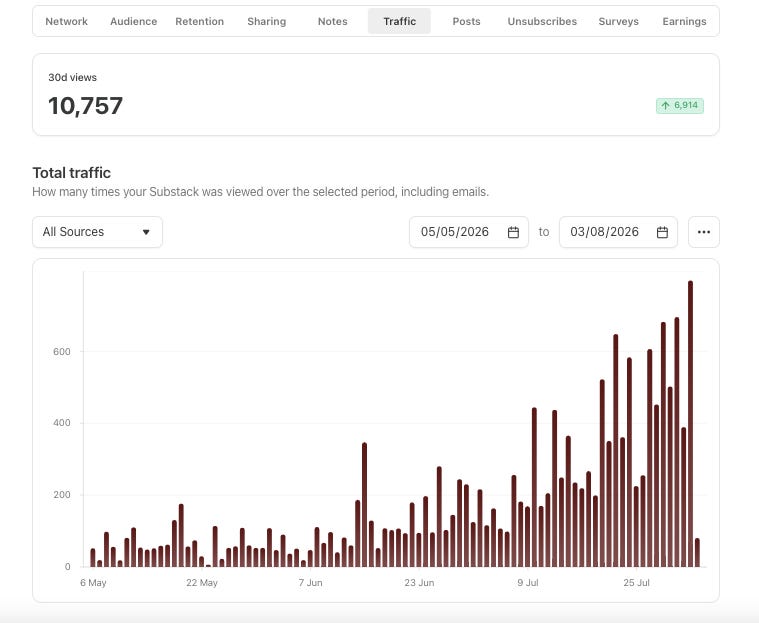
For a smaller creator with less than 1,000 subscribers, I think that’s good. It’s growing exponentially because of all my content, new Notes, relationships, recommendations, the Substack network, others sharing my articles, etc.
Google is right there as another traffic source, even though it’s still small.
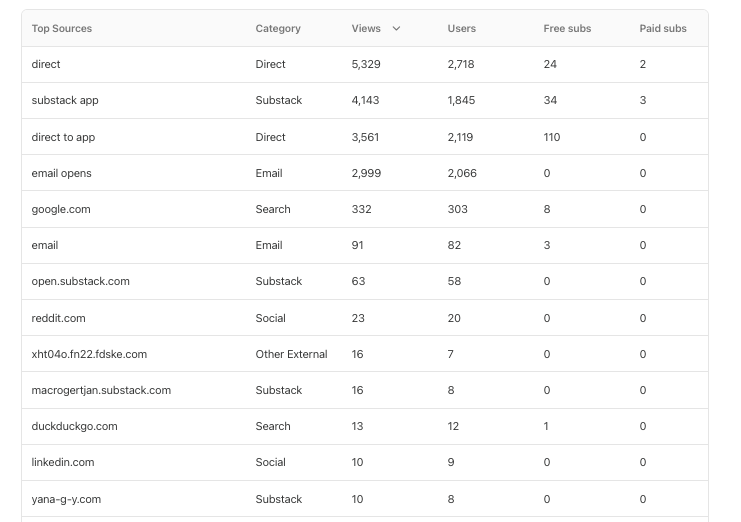
More than 300 new people saw my posts because of showing up on Google, and it brought 8 new subscribers.
I have to add that the quality of these subscribers is high.
Many people on Substack subscribe just to get the same in return, or do it but don’t really open emails. The ones that came from Google, though, typed something in the search bar, found my post thanks to it, liked what they saw, and subscribed.
Now this is how you turn a stranger into a subscriber thanks to your content.
The reason why I’m sharing these screenshots is to show you that I’m also just getting started with Substack SEO (in practice), and plan to increase my organic traffic. So we’re in this together.
SEO is a new discovery channel.
That’s how SEO works, and I hope you understand why it matters.
For Substack writers, that means thinking beyond newsletters.
Here are the exact benefits of optimizing your content so it can get discovered in search engines and by AI tools:
Get discovered by people searching for your topic. Instead of relying only on Notes, recommendations, or social media, readers can find your publication through Google and AI search. SEO creates a whole new discovery channel for people outside of Substack to find you. But more importantly, people who were looking for that kind of content and are interested in the topics you cover to find you.
Your posts keep working long after you publish them. Months and years from now, any post you have that ranks can be bringing you new subscribers. SEO content has a longer lifespan. It can compound over time.
Build authority in your niche. When multiple articles rank for relevant topics, both readers and search engines begin to recognize you as an expert. Then the Internet can keep changing, but your reputation remains your biggest asset.
Increase your visibility in AI search. Helpful, trustworthy content has a better chance of being cited or recommended in tools like ChatGPT, Perplexity, Claude, and Google’s AI Overviews.
Attract sponsorships and brand partnerships. Companies often search Google for experts, creators, and publications in their industry. Ranking for keywords in your niche can help brands discover you organically, leading to collaboration opportunities. That’s actually my favorite monetization method (it’s how I earn over 90% of my blog revenue) and I plan to bring that here too. I will be researching more about how brand partnerships work on Substack and sharing it along the way.
![How I Landed a $450 Brand Deal on Substack as a Small Creator [The Complete Breakdown]](https://substackcdn.com/image/fetch/$s_!EhDf!,w_140,h_140,c_fill,f_webp,q_auto:good,fl_progressive:steep,g_auto/https%3A%2F%2Fsubstack-post-media.s3.amazonaws.com%2Fpublic%2Fimages%2F2d33dec0-4468-402b-a98d-07342222ad4c_1200x630.png)
If you remember just one thing from this post, make it this:
Think of every Substack post as more than a newsletter. It’s also a searchable webpage, a piece of your online portfolio, and another opportunity for readers, AI tools, and even potential sponsors to discover your work.
This is what the Substack SEO challenge is all about, and I will offer you different ways to achieve that result.
Now, tell me, do you have experience with SEO already? Is this the first time you’re learning anything about it? Or maybe you’re familiar but want to finally apply it specifically to Substack?
🎯 ACTION ITEMS
There’s homework for day one, and it’s to take a few important steps.
#1: Define your searchable niche.
Finish the sentence:
“I want to become the go-to Substack publication for ________.”
Throughout this challenge, every optimization you make should help search engines, AI tools, and readers associate you with that topic.
#2: Audit your publication.
Answer these questions:
If someone lands on your publication from Google, will they immediately know what it’s about?
Is your niche obvious?
Would they know why they should subscribe?
It’s okay if you don’t have the clarity you want. What’s important here is to know your starting point.

#3: Connect your Substack to both Google Analytics and Google Search Console.
You can find the steps + screenshots in this post:
![Substack SEO: Connect Your Publication to Google Analytics & Search Console [Step-by-Step Tutorial]](https://substackcdn.com/image/fetch/$s_!glr_!,w_140,h_140,c_fill,f_webp,q_auto:good,fl_progressive:steep,g_auto/https%3A%2F%2Fsubstack-post-media.s3.amazonaws.com%2Fpublic%2Fimages%2F8c849198-bc39-42d0-bc8c-28064ca66272_1200x630.png)
Substack SEO: Connect Your Publication to Google Analytics & Search Console [Step-by-Step Tutorial]
In that post, I also explain why using these 2 tools (which are totally free!) is beneficial, and what the difference between them is.
And that’s it for today. I hope you enjoyed Day 1!
Leave a comment below once you complete the action items and ask any questions you have.
See you tomorrow for Day 2 of the challenge 🤍📈
I just finished Day 1 of the challenge, and I knew I wouldn’t be disappointed. Thank you so much for all the information.
I was genuinely shocked to learn that an indexed Substack can help train AI models. That completely changed the way I see the platform.
It opened my eyes and made me realize there are so many possibilities ahead.
Thank you!!!! ♥️🍾🎉🥳
The split you draw at the top matters more than the tactics under it. Someone arriving from a search already has a question loaded, which makes them a different reader than someone who wandered in from Notes — worth writing the opening for the searcher rather than the browser.